One of the leading innovators of wet cast manufactured stone is EP Henry Corp. Based in Woodbury, New Jersey, USA, the firm is the oldest family-owned and operated manufacturer of precast concrete products in North America.
It’s no wonder homeowners and contractors alike continue to turn to manufactured stone and stone veneer products to improve the look and value of residential and commercial structures. Manufactured stone is consistently ranked among the top performers in return-on-investment (ROI) in Remodeling magazine’s annual Cost vs. Value Report. In 2018, stone veneer was ranked the No. 1 remodeling project with an average ROI of 97.1%. In some regions, the ROI spiked even higher, including the Pacific U.S. region at 125.5%.
One of the advantages of manufactured stone over brick or natural stone is reduced weight of about one-third to one-half. This makes manufactured stone veneer suitable for application on most homes without major structural modifications. Manufactured stone is also easier to install, reducing the time and skill required to achieve optimal results.
Wet cast pioneer
Founded in 1903 by Edward P. Henry, EP Henry manufactures a wide range of paving stone and retaining wall products, including pavers, slabs, permeable pavers, wall systems, cast veneer stone, and accessories. Along with its Woodbury plant, EP Henry also operates manufacturing facilities in Wrightstown and Vineland, New Jersey, as well as Parker Ford, Pennsylvania. The firm’s market encompasses a 10-state region along the mid-Atlantic states and extending west to Ohio.
While EP Henry’s four plants employ high levels of automation for most production operations, one type of product — cornerstones for cast wall systems — had eluded automation attempts for many years. That changed in 2017, when demand for its wet-cast single- and double-sided Cast Stone Wall threatened to outstrip the capacity of its key Wrightstown production line.
“We were using a primarily manual process to create our cornerstone pieces,” notes John Ravelli, EP Henry Vice President of Manufacturing. “We would hand load individual molds on a vibrating table and remove excess material by hand as well. There was a lot of waste and it was very labor intensive. We had to run two shifts with 10 workers on each shift to meet demand.”
Ravelli estimates that up to 60% of the concrete mix used was wasted in this manual wet-cast process. “We had to let it set for a time before we could screed the molds. By then, the mix we screed off was not reusable. We were also having trouble finding labor. Our two shifts were maxed out in terms of production output.”
Help from an automation expert
In mid-2017, EP Henry sought out Montreal-based Automacad, a firm that specializes in creating innovative solutions to manufacturing challenges. Automacad has extensive experience creating custom-designed equipment for dry and wet-cast precasters throughout North America.
“Of course, we knew of EP Henry for many years because they are truly pioneers in wet cast production,” says Automacad president Louis Hébert. “When we met with John and his staff and saw how they were producing the cornerstone pieces it was a perfect opportunity for both our companies. We had this concept in mind for cornerstone production for many years and we were looking for the right customer. We even had a prototype built before we met them. It just needed to be refined and tested in a real-world situation.”
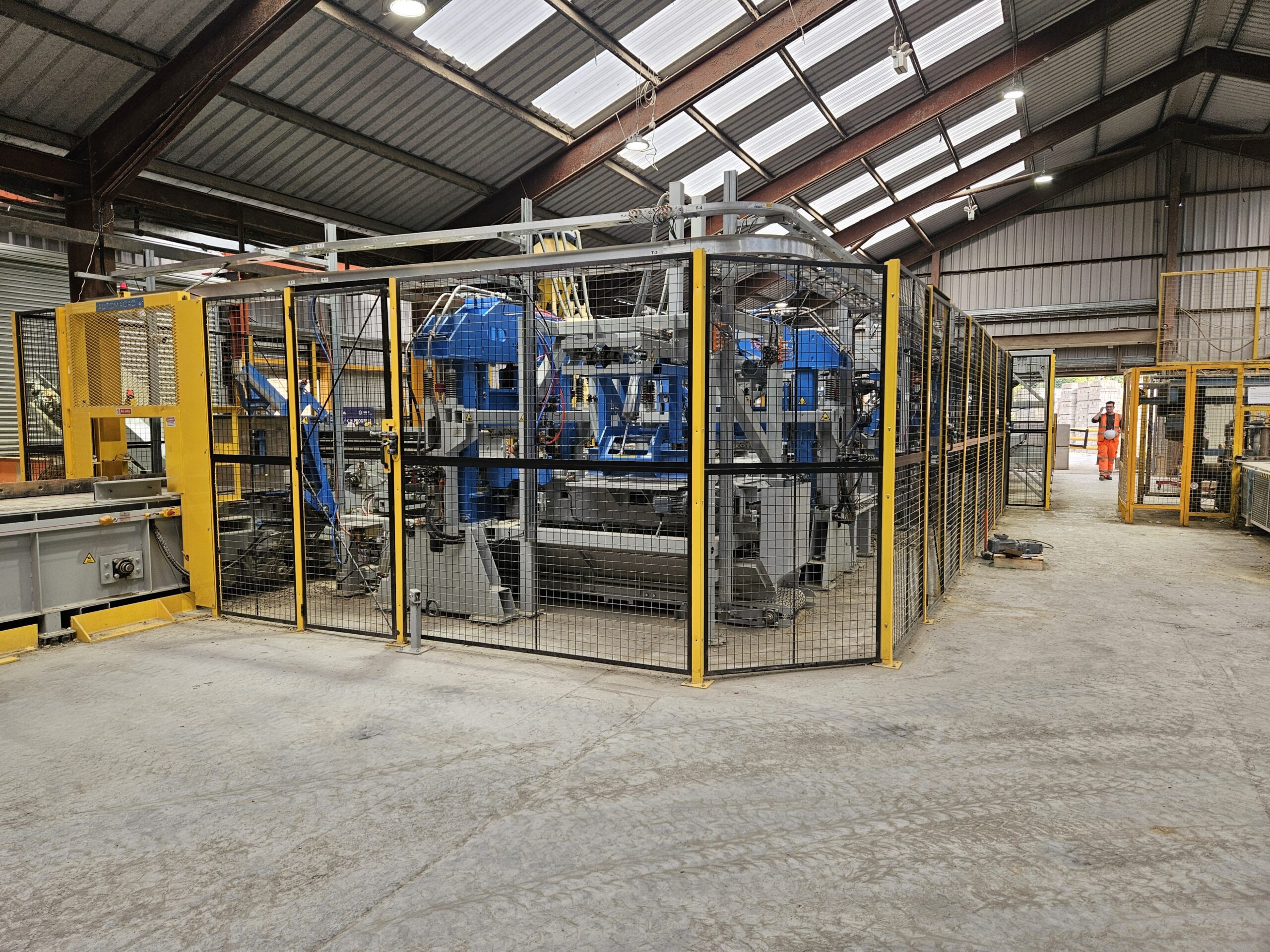
Automacad engineers worked for about six months to build a complete wet-cast cornerstone production system at its facility near Montreal. The automation line includes:
- Automatic destacker — stacks of steel carrier frames holding cornerstone molds are dispensed as needed. The production day begins with a stack of carriers containing product that has cured overnight.
- Demolding station — a patent-pending system lifts the filled mold and gently bends the polyurethane molds to release the cornerstones. Emptied molds are cleaned and placed back in their steel carriers.
- Release agent and color application — carriers move automatically along a conveyor where release agent and color pigment are added. Pigments are added by hand to achieve a natural randomness.
- Automatic filling station — a 1.5 cubic yard (1.15 m³) hopper dispenses the correct amount of mix into each cavity. The mold is vibrated, then automatically screeded. Excess mix is retained and used for the next mold, reducing concrete waste from 60% to about 1%.
- Automatic stacker — loaded carriers are stacked from the bottom up and transported by forklift to a humidity- and temperature-controlled curing area overnight.
“We ran the completed system here at our facility for about two months before we moved it to the EP Henry plant,” explains Hébert. “John and others from EP Henry came up to Montreal to see the system in action and discuss design details.”
A new chapter unfolds
The new cornerstone production system was installed in EP Henry’s 135,000 ft² (12,542 m²) Wrightstown facility in January 2018. The modular pre-assembled line took about a week to install and calibrate.
EP Henry produces its own molds based on real local stones that have been carefully selected and shaped to fit together in natural color patterns. Mineral-based pigments are hand-applied to the molds and become integrated into the lightweight concrete mix when the molds are filled and vibrated. The unique steel carriers were fabricated by a shop near Wrightstown from Automacad’s design. Each carrier can hold 12 or more cornerstones, depending on the product line.
With about 150 carriers, the plant now produces as much product in a single shift as it previously took two shifts to produce. “The automated system has allowed us to reassign and reallocate workers to more productive duties,” Ravelli notes. “We’ve reduced our manual processes for cornerstone production by more than half and cut the production time by half as well.”
Demanding corners
The increased output lets EP Henry meet current demand and adds capacity for the future. “We provide a unique product in the industry and the production of corner pieces has traditionally been a pinch point for us,” notes Mark Fuss, EP Henry vice president of sales. “Contractors and homeowners use a lot of corner pieces in almost every project — not only for 90-degree corners, but also for pillars and piers, which are almost entirely made of cornerstones.”
The automated line has also reduced product breakage. “When production was based on manual labor, there was more product breakage — as much as 20% at times. Now, particularly because of the automated demolding system, we have less than 5% breakage,” Ravelli says. With savings in labour and waste, EP Henry estimated the investment would pay for itself in about two years.
Eric Long, EP Henry President, is pleased with the ROI as well as the flexibility and quality it provides. “We’ve automated the processes that made the most sense and we’re achieving consistent quality and the quantities we need to meet market demand. We have the flexibility to add new products or more of the same any time we need it.”
CPi reprint
This article was first published in Concrete Plant International, North America Edition, issue 5 | 2019.