The series production of large or small-format concrete products with coarse, natural-looking surfaces is particularly challenging, especially to reproduce complex structures with great attention to detail.
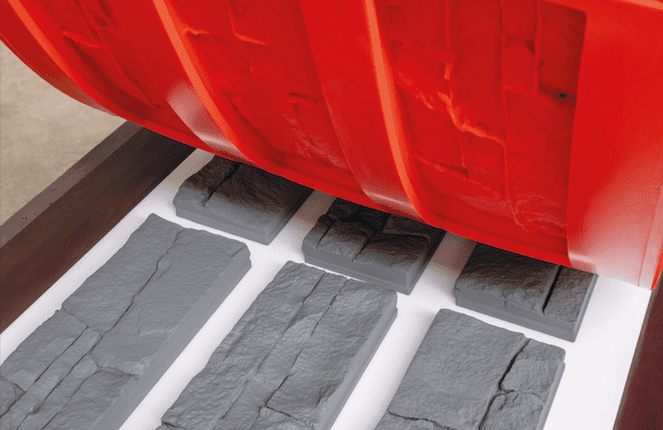
The Canadian company Automacad Inc. and Wasa have collaborated for more than five years to provide solutions for the concrete block industry worldwide. This partnership gives manufacturers the opportunity to produce concrete products with precise surface structures on a large scale using the wet-cast process.
Customised solutions for the wet-cast industry
The two partner companies provide a complete customised solution for the production of concrete blocks using the wet-cast process.
Automacad’s service portfolio
- Automatic or semi-automatic production plants for the wet-cast industry
- Project management and support
- Integration of system components, including concrete mixers, silos, steel reinforcement, curing chambers, slab coatings, packaging and shipping solutions
- Volume-optimised concrete filling for customised products in series production
Service portfolio of Wasa Construct
- Specialised stacking carrier systems for automated carousel systems
- Flexible polyurethane moulds (PU) for demoulding by vacuum or roller
- Product and stone development
- CAD and 3D design services
- Virtual product design
Wasa Compound GmbH & Co. KG, based in Neubrunn, Thuringia, is known worldwide for polyurethane moulds for the wet-cast industry, with customers from North and South America to Europe, Asia and Australia. A decisive factor in recent order growth is the close cooperation with Automacad, an international plant manufacturer for fully automatic wet-cast systems. The partnership began with a conversation during bauma 2019.
Wasa’s stack carrier systems are used in an Automacad plant in the USA. A 35 mm thick Wasa Woodplast® production board, equipped with stacking feet made of high-strength, glass-fibre-reinforced plastic, serves as the base. A robust steel structure ensures the stability and load-bearing capacity of the entire system.
Challenges for wet-cast products in series production
For more than 25 years, Automacad has been an established supplier of automated wet-cast plants. Rapid developments in the sector called for a global partner with a comprehensive portfolio — from specialised stack carrier systems to top-quality tool making and mould construction.
The collaboration combines Automacad’s volumetric filling technology with Wasa’s advanced tool and mould construction. The biggest challenge was ensuring that each product retains the same volume despite different surface structures. Even the smallest deviations can cause overfilling of mould cavities or uneven product thickness.
3D scanning and reverse engineering
In mid-2024, Wasa invested in a Zeiss mobile 3D scanner, including Zeiss Inspect evaluation software and tools for reverse engineering and tool correction. The design team uses the scanner to determine the volume data of 3D models directly on the computer. Integrated AI supports optimal model analysis.
Unlike conventional scanning technologies, which often only capture surfaces, Wasa’s system can precisely analyse volumes and relief structures. Intersections and model structures can be digitised in advance, reducing craftsmanship and transferring many steps to CNC milling.
Wasa can provide Automacad with the exact volumes of concrete blocks early in a project so machine parameters can be adjusted to specific concrete weights. In one current project, a customer could pack 20% more products on a pallet because each product was more precise in its dimensions and weighed less.
Once the digital design is complete, the data is integrated into production. CNC milling and 3D printing are used for precise mould manufacture. Wasa’s flexible polyurethane moulds guarantee exact reproduction of the models as well as longevity and flexibility. The red premium polyurethane is a low-viscosity two-component casting resin with a medium Shore hardness of A45. Moulds are demoulded after 24 hours of curing at 20°C.
Quality control and looking ahead
Wasa uses Zeiss Inspect to verify scanned models and PU moulds as part of a target/actual comparison, setting new standards in dimensional quality assurance.
3D scanning and reverse engineering will become increasingly important in the concrete industry. Combined with 3D printing, they open new possibilities and accelerate prototype development. Wasa is currently working on using these technologies for large-format form liners in the precast concrete industry.
Conclusions
The integration of 3D scanning, reverse engineering and AI-supported software into concrete block production creates new possibilities for customised, high-precision products. Through the cooperation between Wasa and Automacad, customers worldwide benefit from efficient, innovative and flexible solutions that meet the requirements of the modern construction industry.
CPi reprint
This article was first published in Concrete Plant International, Worldwide English Edition, issue 6 | 2024.